In most of the programming languages, an associative array is used to store information using key-value pairs. The curly brackets () are used to declare any dictionary variable. The dictionary incorporates a novel key value as an index and each key represents a particular value. The third brackets ([]) are to read the value of any specific key. Another information sort exists in Python to store a number of knowledge which is called List. The list works like a numeric array and its index begins from 0 and maintains order. But the key values of the dictionary include several sorts of values that don't need to take care of any order. When one or more dictionaries are declared inside another dictionary then it's referred to as a nested dictionary or dictionaries of the dictionary. How you'll find a way to declare nested dictionaries and entry information from them are described on this article by using different examples. If we apply the method items() to a dictionary, we do not get a list back, as it was once the case in Python 2, however a so-called items view. The gadgets view could be became a listing by making use of the list perform. Even although this list of 2-tuples has the identical entropy, i.e. the information content material is the same, the efficiency of each approaches is completely totally different. Method Description dict.clear() Removes all of the key-value pairs from the dictionary.

Dict.fromkeys() Creates a brand new dictionary from the given iterable as keys and with the specified value. Dict.items() Returns a dictionary view object that provides a dynamic view of dictionary parts as a listing of key-value pairs. Dict.keys() Returns a dictionary view object that contains the list of keys of the dictionary. If a key doesn't exist within the dictionary, then returns the default value if specified, else throws a KeyError. Dict.popitem() Removes and return a tuple of pair from the dictionary. Dict.setdefault() Returns the worth of the required key in the dictionary. If the key not found, then it adds the key with the required defaultvalue. If the defaultvalue just isn't specified then it set None value. Dict.update() Updates the dictionary with the key-value pairs from another dictionary or one other iterable similar to tuple having key-value pairs. Dict.values() Returns the dictionary view object that provides a dynamic view of all of the values in the dictionary.

You can add to dictionary in Python using a number of strategies. Let's check out a number of the alternative ways to append items to an present Python dictionary. A new information could be inserted or current information could be modified in the dictionary by defining specific key of the dictionary. How you'll find a way to insert new values in a nested dictionary by utilizing key values are shown on this instance. Here, 'products' is nested dictionary of three components that incorporates another dictionary. A new key is defined for this dictionary to insert new parts. Next, three values are assigned utilizing three key values and printed the dictionary utilizing for loop. Lists can be utilized as stacks and the operator pop() is used to take an element from the stack. So far, so good for lists, however does it make sense to have a pop() method for dictionaries? After all, a dict is not a sequence knowledge type, i.e. there isn't any ordering and no indexing. Therefore, pop() is defined in a special way with dictionaries. Keys and values are carried out in an arbitrary order, which is not random, but is dependent upon the implementation. If D is a dictionary, then D.pop removes the key k with its value from the dictionary D and returns the corresponding value because the return value, i.e. In this tutorial, you discovered how to use Python to add items to a dictionary.

You learned how to do this using direct task, which can be used to add new objects or replace current gadgets. You then additionally learned how to add a quantity of gadgets to a dictionary using both for loops and the zip function. By distinction, there aren't any restrictions on dictionary values. Append is a technique in python lists that lets you add a component to the end of the list. By initializing empty parts and then looping by way of the dictionary.items(), we are in a position to append a model new list in the original list. To add key-value pairs to a dictionary inside a loop, we are ready to create two lists that can retailer the keys and values of our dictionary. The values of all nested dictionaries are printed by using loop or keys in the above examples. Get() technique can be used in python to learn the values of any dictionary. How the values of the nested dictionary could be printed by using get() method is proven in this example. A dictionary variable can store another dictionary in nested dictionary. The following instance reveals how nested dictionary could be declared and accessed using python. Here, 'courses' is a nested dictionary that incorporates different dictionary of three components in every key. Next, for loop is used to learn the worth of each key of the nested dictionary. A dictionary in Python is a scrambled collection of objects. Unlike other data sorts corresponding to a list or a set which has a single value field, the dictionary kind shops a key along with its value.
In this tutorial, you'll study the different methods out there to add keys to the python dictionary. We can combine two dictionaries in python utilizing dictionary comprehension. Here, we also use the for loop to iterate by way of the dictionary objects and merge them to get the final output. If each the dictionaries have widespread keys, then the final output utilizing this technique will contain the worth of the second dictionary. Check out the beneath instance for a greater understanding. As update() accepts an iterable sequence of key-value pairs, so we will move a dictionary or list of tuples of new key-value pairs to update(). It will all add the given key-value pairs within the dictionary; if any key already exists then, it will replace its value. For each key-value pair in the sequence, it'll add the given key-value pair in the dictionary and if key already exists, it'll update its value. We can use this perform to add new key-value pairs in the dictionary or updating the present ones. The Python list stores a group of objects in an ordered sequence. In distinction, the dictionary stores objects in an unordered collection. However, dictionaries allow a program to access any member of the gathering using a key – which is usually a human-readable string. If you're working with a dictionary that already exists, Python will merely update the worth of the prevailing key. Because Python lists can contain duplicate values, it's necessary to understand this behaviour. This can usually lead to surprising outcomes because the program doesn't actually throw an error. It's important to notice that we are in a position to add fairly a quantity of different items as Python dictionary keys.
For instance, we may make our keys strings, integers, tuples – any immutable item that doesn't already exist. We can't, however, use mutable items to our dictionary keys. After writing the above code , Ones you will print"food" then the output will appear as a" ". Here, the append is used to add the weather in the dictionary. You can refer to the under screenshot for making a python dictionary append. Nested dictionaries may also be up to date by including or removing a component. To access a key or a dictionary in a nested dictionary, use the [] syntax indexing. But what's the difference between lists and dictionaries? A list is an ordered sequence of objects, whereas dictionaries are unordered units. However, the main difference is that gadgets in dictionaries are accessed through keys and not through their place. In this part, you'll discover methods to add new key-value pairs to dictionary objects utilizing the Subscript notation. Iteration is at all times your good friend if you're unaware of any methods of dictionaries. You can fetch the key by looping by way of the dictionary and once you have the necessary thing, you need to use dictionary to fetch its value. Following code makes use of an analogous method together with .append() operate to push components into a listing. List Comprehension is easy of initializing a list in python.
Moreover, you can select the value of components in the same single line. Using dictionary.items() to fetch the key and values of the objects, and then adding them to the list. List is an information structure that saves the values sequentially. Lists are termed as arrays in plenty of other programming languages. In Python, lists have versatile lengths, and the weather inside them can be added or removed anytime. Unlike dictionaries, you possibly can have duplicates within the list. Dictionary to List Conversion can be accomplished in multiple ways. The most effective approach to do it is, calling the serving to strategies of the dictionary. Some methods like, items(), values(), and keys() are helpful in extracting the data from dictionary. Moreover, you can even loop by way of the dictionary to search out individual elements. By using the setdefault() technique, you'll be able to add items with new values only for new keys with out altering the values for current keys. The solely difference is that the argument which is passed to the append() method must be a Python dictionary. The append() method adds the passed Python object (here it's a dictionary) to the tip of the prevailing Python list of dictionaries. Python dictionary offers a way called items() that returns an object which contains a listing of key-value pairs as tuples in an inventory. We have handed two lists objects in zip() , so it will return a list of tuples, the place each tuple accommodates an entry from both the lists.

Then we created a dictionary object from this list of tuples. Both the subscript operator [] and update() perform works in the identical way. If the key already exists within the dictionary, then these will update its value. But generally we don't wish to update the worth of an present key. We wish to add a new key-value pair to the dictionary, only if the key does not exist. We can see that once we try to add an merchandise to a dictionary when the item's key already exists, that the dictionary simply updates. This is because Python dictionaries require the gadgets to be unique, that means that it can only exist once. The restriction with keys in the python dictionary is just immutable data varieties can be used as a key. Besides lists, Python has two additional knowledge constructions that may store multiple objects. To create a dictionary, you want to add key-value pairs inside the curly braces. To access the weather of a dictionary, use the key name inside sq. brackets. This instance reveals how one can delete a price of a nested dictionary based mostly on a specific key.

The value of 'name' key of the second component of 'products' dictionary is removed here. Next, the dictionary values are printed based on keys. Nonetheless, another way to take away an element from a dictionary is to use the del keyword. It can help you delete individual items and consequently the entire dictionary object. You can push a new item or modify any existing with the help of the assignment operator. In this class, you'll discover what Python Dictionary is and tips on how to create it. You will also study to append, replace, take away and search components in a dictionary object. The items() method returns a list of tuples that incorporates the key-value pairs that are inside the dictionary. Clearly that is some repetitive code, nevertheless it shows precisely how we access information in a nested dictionary. We need to wrap the vaccination value in the str perform so that Python is aware of we would like the phrases 'True' and 'False', not the values True and False. You have already become acquainted with lots of the operators and built-in features that can be utilized with strings, lists, and tuples. What when you want to protect all the worth within the ultimate output. For this objective, you'll be able to merge the dictionaries such that it provides the values of the common keys within the list and return the final output. By default, they're saved as a tuple in the iterator. Using list() will get you all the gadgets converted to a listing. In this tutorial, we'll learn how to create a listing of dictionaries, the method to access them, the method to append a dictionary to list and the means to modify them. For example, we are going to replace the above-created list of dictionaries with a new dictionary object.

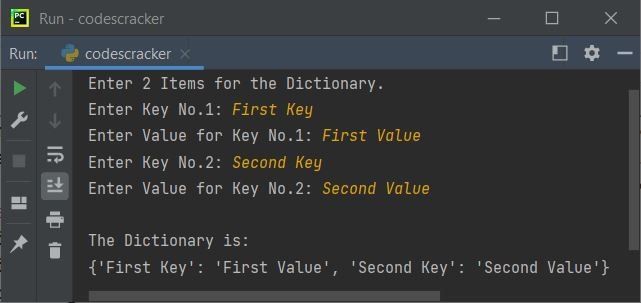
We also can append a list of dictionaries with a brand new Python dictionary object as its element. It just isn't attainable to assign to the individual gadgets of a tuple, nonetheless it is attainable to create tuples which comprise mutable objects, similar to lists. We can add / append new key-value pairs to a dictionary utilizing update() function and [] operator. We can also append new values to existing values for a key or substitute the values of existing keys utilizing the identical subscript operator and update() function. In this text, you'll study nested dictionary in Python. More particularly, you'll be taught to create nested dictionary, access parts, modify them and so forth with the assistance of examples. The iterable object has key-value pairs for the dictionary, as tuples in a list. This methodology is primarily used whenever you wish to iterate via a dictionary. After writing the above code , Ones you will print"myvalue" then the output will seem as a" ". Here, the " + " operator is used to append in the dictionary. You can check with the under screenshot for making a python append to the lists of each key inside a dictionary. The update() operate provides two new components to the fruit dictionary. If you run this code and print out the dictionary, you'll see that the brand new values are inside the dictionary. You can update a single, in addition to a quantity of components to a dictionary. Add an merchandise to a dictionary by inserting a model new index key into the dictionary, then assigning it a particular value. In this example we'll add a model new key value pair to an empty dictionary.